


A commercial grow light should be evaluated as a complete piece of equipment, not simply a wattage figure, an LED brand or a long lifetime claim. Before committing to a roomful of fixtures, check the identity of the supplied model, driver documentation, thermal limits, output evidence, installation requirements and written after-sales arrangements.
This commercial grow light reliability checklist is designed for South African buyers moving from a shortlist to a purchase decision. It focuses on what to verify before payment, what to inspect on delivery and what to record before accepting an installation. Use it for a single replacement fixture or a larger procurement project.
Still deciding which specifications your project needs? Start with our professional LED grow light buying guide. Once the specification is clear, use the checks below to assess whether the quoted equipment and support arrangements meet it.

Commercial grow light reliability: the quick checklist
Keep a copy of the supplier's answers with the quotation. A useful answer identifies the exact fixture and the conditions behind the claim; a general assurance is something to clarify before ordering.
| Check | Evidence to request | Question to resolve before purchase |
|---|---|---|
| Fixture identity | Model, version, product label and package contents | Does the supplied configuration match the quotation and reports? |
| Driver and controls | Driver identification, supported controller and connection instructions | Who handles a driver fault, and what replacement route is available? |
| LED life and output maintenance | Applicable test data and the basis of any lifetime projection | Does the claim concern the LEDs, the complete fixture or the warranty? |
| Heat and environment | Rated operating conditions and installation clearances | Is the intended location within the documented limits? |
| Light distribution | A traceable PPFD map and its measurement conditions | Can the quoted coverage be checked on a like-for-like basis? |
| Installation | Mounting instructions, fixture weight and required accessories | Has a competent installer checked the support and electrical arrangements? |
| Service and delivery | Written warranty, exclusions, claim process and delivery terms | Who is responsible for parts, labour, transport and communication? |
| Acceptance | An agreed inspection record and discrepancy process | What evidence will demonstrate that the delivered order matches the agreement? |
The aim is not to collect the most impressive-looking documents. It is to connect each claim to the equipment you will actually receive.
Verify the exact fixture, not just a familiar component brand
Start with a consistent model reference across the quotation, label, specification sheet and test report. Ask the supplier to identify any options that change the delivered configuration, such as the driver, control interface or supplied accessories. Record substitutions explicitly rather than assuming that similar-looking fixtures are interchangeable.
A recognised LED name can be a useful starting point for questions, but it does not establish the performance of the assembled light. The US Department of Energy's LED basics guide distinguishes LED-source efficacy from complete-luminaire efficacy and explains that fixture design and power-supply efficiency affect the result.
For LED diode quality, request the component identification and relevant supporting documentation. Then bring the discussion back to the whole product: its electrical input, output, cooling, connections and service arrangements. Do not substitute a diode brochure for a fixture report.
A TheOneGrow product-page example
The TheOneGrow 200W LED panel listing publishes rated power of 200 W, PPF of 520 µmol/s and system efficacy of 2.6 µmol/J. These are published specifications, not independent proof of field reliability.
Use them as the start of a verification request: ask for the exact model on the quotation, matching product documentation and the warranty that applies to that order. Do not infer a service life, failure rate or commercial suitability for an entire project from those figures alone.
Check driver reliability and the repair route
Ask for the driver model and the operating conditions attached to its documentation. Clarify whether the driver is integrated or separately mounted, which controller combinations are supported and whether service requires returning the whole fixture.
The distinction matters because gradual loss of light output is not the same as sudden equipment failure. The Department of Energy describes electronics failure as a possible cause of a luminaire stopping even while its LEDs remain serviceable. A long LED-life statement therefore does not answer the driver-reliability question.
For a commercial order, put these practical questions in writing: who diagnoses a fault, who authorises a repair, what parts can be supplied and what happens while the unit is away? Ask whether any quoted replacement availability is current stock or an estimate. Neither answer should be assumed from a product photograph.
Do not open a driver or substitute electrical parts to investigate a new purchase. Follow the supplier's service process and have electrical work handled by an appropriately qualified person.
Separate LED lifespan, output maintenance and warranty
Treat a large operating-hours claim as a request for supporting detail, not as a promise that every fixture will run faultlessly for that period. Ask what is being measured, what operating conditions apply and whether the statement is based on testing or a projection.
The DesignLights Consortium's horticultural lighting requirements address photon-output maintenance, driver lifetime and warranty separately. That is a useful distinction for buyers; it does not mean a particular product is DLC-qualified or that those programme requirements are South African law.
Create separate entries in your comparison for the lifetime claim and the written warranty. Under the warranty entry, record the covered components, exclusions, remedy and claim procedure. Leave an unanswered point marked as unresolved rather than filling it with a lifespan figure from another model.
For a larger rollout, consider an initial evaluation order with agreed checks before committing to the remaining quantity. Treat that evaluation as an acceptance exercise, not proof of years of future service.
Evaluate heat management and environmental limits
LED lighting is not heat-free. ENERGY STAR's explanation of LED thermal management describes heat sinks transferring heat to the surroundings and explains that higher LED operating temperatures can accelerate light degradation and shorten useful life.
Check the rated operating environment and the manufacturer's clearance requirements for the exact fixture. Ask how its cooling arrangement is intended to work in your proposed installation. Keep the driver location, access for cleaning and any restrictions on enclosing the light in the installation brief.
Do not assume that a fixture will operate safely in every cold, hot or humid space simply because it uses LEDs. Where a supplier presents a thermal report, check that its fixture configuration and test conditions are relevant to the product being offered.
Treat safety claims as model-specific evidence
UL Solutions' horticultural lighting guidance identifies concerns including optical exposure, electrical safety and suitability for damp or wet environments. A retail listing or an LED label is not a substitute for documentation addressing those concerns.
Request any claimed certification or test report for the supplied model, together with the installation and handling instructions. For an IP-rated product, clarify which parts of the assembly the rating covers and the conditions of use. Do not turn an ingress-protection claim into permission to ignore connector, driver or cleaning restrictions.
Keep inspection and maintenance consistent with the manual, including electrical isolation where required. Ask the supplier about the appropriate precautions for working near the light; do not assume that every fixture has the same exposure characteristics.
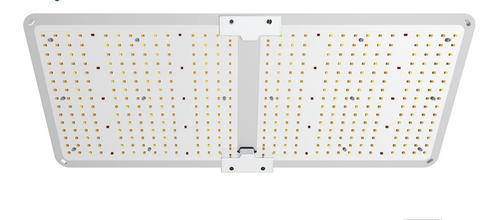
Verify useful light output and coverage
A reliability checklist also needs to confirm that the product delivers the kind of output you are buying. Keep the terms distinct: electrical power describes input, PPF describes photosynthetic photon output, and PPE expresses that output relative to electrical input. The DLC glossary explains these quantities.
A PPFD map adds the distribution of photon flux across a measurement area. Request the model, test footprint, measurement height, operating setting and test environment alongside the map. Compare equivalent conditions rather than a centre reading from one setup against an average from another.
Do not assess horticultural output through apparent brightness or a universal lux conversion. Apogee Instruments explains that conversion between PPFD and lux varies with the light source. For a detailed map-reading discussion, use our high-power LED grow light coverage guide.
Keep crop requirements and equipment acceptance as separate parts of the project brief. Specify the application with your lighting designer or crop specialist, then evaluate the supplier's evidence against that requirement. Do not infer fixture quantity, spacing or suitability from a generic wattage-to-area rule. Record the actual layout proposed for your space instead.
Plan installation and control checks before delivery
Decide how the fixture will be supported before ordering mounting accessories. Use the manufacturer's approved mounting method; do not assume that every installation requires drilling into a ceiling. Have the support structure, hardware and electrical arrangements assessed by a competent installer.
For the linked TheOneGrow panel, the published instructions call for checking the selected option, using suitable hanging points, keeping connections dry and disconnecting power before installation or maintenance. Use the instructions supplied with the actual equipment rather than applying a generic hanging method to every fixture.
Agree on the control checks in advance. Request confirmation of the supported controller, required cables or adaptors, dimming functions and documented behaviour after a power interruption. Have functional checks performed within the manufacturer's instructions, without bypassing protective equipment or exposing live components.
Where a project uses an inverter, generator or other backup supply, obtain compatibility confirmation for the complete arrangement from the supplier and installer. Do not infer compatibility from the connector shape or from another customer's installation.
Record the final mounting arrangement, controller configuration and equipment references in the handover documents. This gives the service provider a defined installation to refer to if a problem arises later.
Confirm South African warranty, delivery and after-sales terms
Ask who will handle the claim in South Africa and whether assessment, repair or replacement takes place locally. Get the responsibility for collection, return transport, labour and replacement parts in writing. A warranty duration alone does not explain the practical process.
For a phased commercial order, clarify whether later deliveries will use the same documented configuration. Ask what happens if that version is no longer available, and how a proposed substitute will be evaluated. Keep any agreed response times or spare-unit arrangements in the quotation rather than relying on a verbal understanding.
TheOneGrow's shipping policy distinguishes estimated delivery times from guarantees and states that the shipping charge or promotion shown at checkout applies. Confirm any special delivery arrangement before payment. An advertised delivery offer should not be treated as a commitment about future warranty transport.
For an installation with a fixed handover date, request an order-specific stock and dispatch confirmation. Allow the project plan to distinguish receipt of the goods from completion of installation and acceptance checks.
Compare total ownership cost, not just purchase price
Build a comparison around your own project assumptions. Include fixtures, necessary controllers and mounting accessories, installation, electricity, planned maintenance, possible repair transport and provision for a spare or temporary replacement.
For electricity budgeting, use the documented input at the intended operating setting, your operating-hours assumption and your actual tariff. Label estimates clearly. Avoid a universal claim that one light will save a fixed amount or replace a much higher-wattage product without a comparable performance basis.
Put downtime in a separate line. Decide what happens if a unit is unavailable and what contingency the project needs. A lower purchase price with unanswered service questions may still be worth considering, but compare it as an unresolved proposal rather than assuming the missing support is included.
The objective is a transparent buying decision, not the longest list of promises. Keep the same assumptions across competing quotations so that price differences remain meaningful.
Use an arrival and commissioning acceptance record
Agree on the checks before the shipment arrives. The following record can be adapted to the quotation and the manufacturer's instructions; it is not a substitute for electrical certification or specialist testing.
| Stage | What to record | How to handle an unresolved item |
|---|---|---|
| Before payment | Agreed model, quantities, included accessories, relevant reports and service terms | Ask for the missing document or a written clarification. |
| On arrival | Carton condition, label, model, serial references and supplied components | Photograph discrepancies and contact the supplier promptly. |
| Before installation | Matching instructions, approved support arrangement and installer review | Keep the affected equipment out of use until the concern is resolved. |
| Initial operation | Approved functional checks, control response and visible or audible abnormalities | Record observations without opening or modifying the fixture. |
| Performance acceptance | Agreed output checks, instrument and measurement conditions | Compare against the agreed basis, not an unrelated marketing image. |
| Handover | Accepted items, outstanding items, supplier response and responsible contact | Keep the record with the invoice and warranty documents. |
TheOneGrow's shipping policy asks buyers to report damaged, incomplete or incorrect deliveries promptly with the order details and appropriate photographs. Preserve packaging and the delivery record while the supplier advises on the next step.
Acceptance should establish whether the delivered equipment matches the agreement and functions as expected within the checks performed. It should not be described as proof that the fixture can never fail.
Frequently asked questions
Does higher wattage make a grow light more reliable?
No. Wattage describes electrical input, not a reliability rating. Compare the exact fixture, its driver and thermal documentation, relevant output evidence and service arrangements. Choose the required performance for the project, then check the evidence supporting the supplied unit.
Is a long LED lifespan the same as a warranty?
No. An output-maintenance or operating-life claim describes a performance expectation under stated conditions. A warranty describes the supplier's commitments and exclusions. Request both documents and read them separately; do not use one as a substitute for the other.
Can a PPFD map prove that a commercial grow light will last?
No. A map describes light distribution under the stated measurement conditions. Keep it in the acceptance evidence, but assess lifetime claims, driver documentation, installation limits and after-sales terms separately. Good coverage evidence does not answer every reliability question.
What should I ask before placing a bulk order?
Request an exact configuration, a dated specification, applicable test information, installation instructions, controller requirements, warranty terms and an order-specific delivery plan. Agree how substitutions, missing accessories and acceptance discrepancies will be resolved before committing to the full quantity.
Can I replace a failed driver with a similar-looking unit?
Do not make that decision from appearance alone. Ask the supplier for the approved service route and authorised replacement specification. Have any electrical replacement undertaken by an appropriately qualified person, and confirm the implications for the warranty before work begins.
Make the next step a documented comparison
The most useful commercial grow light reliability check is a question the supplier can answer for the actual order: what is being supplied, what evidence supports it, how should it be installed, and what happens if something goes wrong?
Bring those questions to TheOneGrow's team with your project location, equipment shortlist, intended layout and control requirements. Request the applicable product documents and written support terms before finalising the purchase. A clear record is more useful than assuming that a familiar brand, bright demonstration or impressive headline has answered every question.